“Professional knowledge and professional competence are the main attributes of leadership. Unless you know, and the men you command know that you know your job, you will never be a leader.”
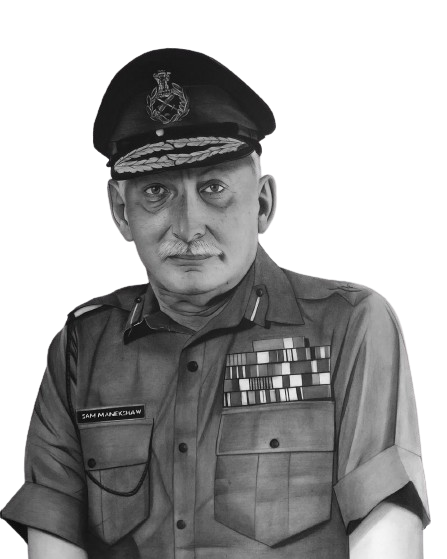
3 April 1914 - 27 June 2008
“Professional knowledge and professional competence are the main attributes of leadership. Unless you know, and the men you command know that you know your job, you will never be a leader.”
Field Marshal Sam Hormusji Framji Jamshedji Manekshaw (3 April 1914 – 27 June 2008), also known as Sam Bahadur ("Sam the Brave"), was the Chief of the Army Staff of the Indian Army during the Indo-Pakistani War of 1971, and the first Indian Army officer to be promoted to the rank of field marshal. His active military career spanned four decades and five wars, beginning with service in World War II.
Sam Manekshaw was born in Amritsar, Punjab, on April 14, 1914, to parents Hormizd and Hilla Manekshaw.Instead of joining the University of Punjab, Sam enrolled at the Hindu Sabha College in Amritsar in April 1932, obtaining a third-class science degree. In 1931, the Indian Military College Committee proposed the establishment of a school to train Indians as military officers, which required approval from Congress.Sam took and passed the Delhi entrance exams conducted by the Public Service Commission.On October 1, 1932, Sam Manekshaw was selected as one of fifteen cadets after a public competition for the three-year training program.
Sam Manekshaw was one of fifteen cadets chosen through an open competition on October 1, 1932.After the training, he was commissioned on February 4, 1935, and was assigned to the 2nd Battalion of Royal Scots in Lahore.In May 1938, he was assigned to the 12th Frontier Force Regiment in Burma, where he was appointed as the company quartermaster.1939 World War 2 broke out, and he was assigned his duty in Burma. After this, Sam Manekshaw’s battle and war life started.Sam Manekshaw’s 12th Frontier Force Regiment became part of the Pakistan Army after the partition of India. After this, Sam was moved to the 8th Gorkha Rifles.In 1957, he attended the Imperial Defense College in London for advanced command training. On his return, he was named General Officer Commanding (GOC) of the 26th Infantry Division, with the acting rank of major general, on December 20, 1957.On June 8, 1969, Manekshaw was named the eighth Chief of the Army Staff.In July 1969, Manekshaw visited a battalion where he inquired to an orderly about his chief’s name. The orderly confirmed that he knew, and when asked to name the chief, he responded, “Sam Bahadur.”
When the West Pakistani government rejected East Pakistan's call for more autonomy, a separatist movement emerged in Bangladesh.As the 1971 India-Pakistan War loomed, Prime Minister Indira Gandhi sought assurance from Sam Manekshaw about the readiness of the Indian Army.Manekshaw was confident that India could emerge victorious by fighting on his terms. His strategy involved utilizing all three Indian Army forces and receiving support from the Mukti Bahini.The Mukti Bahini was a Bangladeshi guerrilla group of 75,000 fighters that fought for East Pakistan's liberation. They disrupted Pakistan's supply lines and communications and aided the Indian Army with crucial information.The formal outbreak of war occurred on December 3, 1971, when the Pakistan Air Force bombed Indian Air Force sites in western India.Under Manekshaw's leadership, the Indian Army implemented a combined-arms strategy that decisively defeated Pakistani resistance in the eastern part of the conflict.By December 9, 1971, the Indian Army had captured key areas and effectively surrounded Dhaka. Manekshaw urged the Pakistani forces to surrender unconditionally, offering decent treatment and protection from the wrath of Bangladesh's population.On December 16, Pakistan's army commander accepted Manekshaw's surrender offer, resulting in over 90,000 Pakistani soldiers becoming prisoners of war. This marked the formal end of the war and the birth of Bangladesh as a new nation. Manekshaw was hailed as a war hero, and Indira Gandhi intended to appoint him as the first Chief of the Defense Staff and promoted him to Field Marshal. However, bureaucratic obstacles and other issues prevented Manekshaw from assuming the Chief of the Defense Staff position.
1939 World War 2 broke out, and Sam Manekshaw was assigned his duty in Burma. This was his first major battle to be fought. He was wounded badly during his fight with Japanese forces at the Sittang River. After contributing to World War 2, he was promoted to substantive captain on February 4, 1942. In 1947, when Pakistani forces penetrated Kashmir on October 22, 1947, Sam Manekshaw was going to start his new job as the commanding commander of the 3rd Battalion, 5 Gorkha Rifles. While conducting aerial surveillance on the oncoming Pakistani Army, he found a Pakistani army presence in Kashmir, his second major battle. In 1971, India-Pakistan War was about to start, and this was his most important war contribution. He led this war and made India victorious.
Field Marshal Sam Manekshaw was awarded the Padma Vibhushan by the President of India in 1972 for his service to the Indian country. He became India’s first Field Marshal on January 1, 1973. After nearly four-decade of service, Sam Manekshaw retired from active duty on January 15, 1973. He and his wife, Silloo, settled in Coonoor, Tamil Nadu, a civilian town near Wellington Cantonment. In 1977, Nepal's King Birendra bestowed him with the Order of Tri Shakti Patta. It was an order of knighthood of the Kingdom of Nepal. He served as an independent director on the boards of various companies after retirement, and in a few cases, as the chairman. At 94, Manekshaw died of pneumonia complications at the Military Hospital in Wellington, Tamil Nadu, on June 27, 2008. Vijay Diwas is commemorated every 16th December to honor the victory won under Manekshaw’s leadership in 1971 against Pakistan. The Manekshaw Center in Delhi Cantonment is named after him, and this is the greatest institution of the Indian Army.
Every year, on 16 December, Vijay Diwas is celebrated to commemorate the victory led by Manekshaw in 1971. On 16 December 2008, then-President Pratibha Patil issued a postage stamp featuring Manekshaw in his field marshal's uniform. The Manekshaw Centre, a prestigious institution of the Indian Army, is located in Delhi Cantonment. It is a state-of-the-art convention center spread across 25 acres of landscaped area and was inaugurated by the President of India on 21 October 2010. The biannual Army Commanders' Conference, which formulates policy, takes place at this center. The Manekshaw parade ground in Bangalore is named in his honor and hosts the Republic Day celebrations of Karnataka every year. In Ahmedabad's Shivranjeeni area, a flyover bridge was named after him in 2008 by the then Chief Minister of Gujarat, Narendra Modi. To honor him, a granite statue was erected in Wellington, near the Manekshaw Bridge on the Ooty-Coonoor road in the Nilgiris district in 2014. The Manekshaw statue can also be found on Menckji Mehta Road in Pune Cantonment.
“Give me a man or a woman with common sense who is not an idiot, and I assure you can make a leader out of him or her.”
“Unless you know, and the men you command know that you know your job, you will never be a leader.”
“If a man says he is not afraid of dying, he is either lying or is a Gurkha.”
Learn more on Wikipedia